

.png)





Member of the U.S. Council on Foreign Relations Dr. Jiri Valenta visited Armenia in September 2009 and met the ACGRC staff.
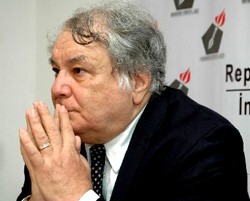
Dr. Valenta's interview to Iravunk de facto bi-weekly (Part I published in issue #80, Part II – in #81)
Americans Are Not Racists; Otherwise We Wouldn’t Have a Black President
“Putin is not just a man from KGB, he has two faces – Western and Eastern, as Russia does”
- Mr. Valenta, what is the cause of your visit to Armenia?
- I may say it’s a study visit; we have just visited your genocide monument.
- US President Barack Obama uttered the word yeghern in Armenian.
- Yes, yeghern, and what we’ve seen there was very impressive, in the emotional sense. We have spent three hours there, have read and bought books. So many people were murdered!
- You study the post-Soviet countries and the reasons for the breakup of the USSR. But first of all, are you a Democrat or a Republican?
- I’m a Republican.
- It’s interesting to hear your opinion about the reasons for the breakup of the USSR. A bit later I’ll make clear why I ask about that.
- There were many reasons. First of all, the war in Afghanistan. The Polish crisis. The third reason, about which Gaydar also wrote – USSR faced very severe problems. Just consider: when the Russians invaded Afghanistan, oil price had been very high, but later it plummeted.
- But it seems now that situation is very similar: involvement in Afghanistan is still there, oil price goes down, Russia is an oil addict; it’s enough to bring the oil price down, and Russia will implode. And, by the way, political scientists have been stating that at that time oil price plummeted because the USSR’s breakup was desired. And now, it is needed to divide Russia into several states.
- I don’t think so. Nobody knows what will happen. You know, no one needs to divide Russia. We need Russia that has a stable democratic future. I think that is indeed a difficult issue - Putin is not just a man from KGB, he has two faces – Western and Eastern, as Russia does.
- You are a Republican, but you quote Obama, a Democrat, saying that Putin has remained in the past with one foot and moved the second foot into the 21st century with reluctance.
- I don’t think so. Obama is an intelligent leader, I’m very proud that he has mixed ethnicity and has good relations with the Arab world, and besides, we, Americans, have shown that we are not racists, otherwise we wouldn’t have a black president; but Obama doesn’t have serious experience, and he is rather radical, as Bill Clinton was in his youth. It’s a pity that Obama has made some unacceptable moves – I mean his stepping back from deployment of anti-missile defense system in the Czech Republic and Poland, that is a grave mistake.
- Wow! But it seems that for such and similar actions he has got the Nobel Prize. By the way, by such actions he wins our sympathies as well, we like that guy.
- You like him because the military bases will be deployed in the Caucasus.
-Yes, in Georgia.
-Maybe. That’s not clear yet. But you know, when Obama makes the first step, and the second, he must make the third step as well. If one starts to do something and cannot accomplish it, he must return to the starting point. That resembles Jimmy Carter’s actions: we would begin something and there would be a failure. In the beginning, he was very soft, but later, in same Afghanistan, in took tough actions.
- So, you Republicans oppose creation of a multipolar world, to compromising, particularly with Russia?
- In Russia they know very well how to use soft people.
- Mr. Valenta, but Russia has also made reciprocal steps – deployment of Iskander missiles in Kaliningrad was cancelled and Russia “sold” Iran.
- No, that wasn’t a deal, especially concerning the Iskander missiles. I don’t think that Russians really wanted to deploy them.
- And what about Iran?
- As a matter of fact, there hasn’t been a compromise about the Iranian issue. You know where a compromise was reached? On the Afghan issue. Russians have been playing a serious game in the Central Asia: they stimulated Kazakhstan and Uzbekistan to open the way for the Americans for entering Afghanistan, so nine years ago we were able to win the war. There has also been a compromise concerning Poland. But no one speaks about it, I don’t know why.
(continued below)
Russian Presence in Armenia Will Be Needed Yet
“We can say that Bush was primitive, but Bush wasn’t naïve at all”
- Mr. Valenta, let’s talk about Obama. In your opinion, what kind of policy is realized by the young Afro-American president?
- Before Obama became US president, I had discussions about him with different people, including Kennedy’s first aide. He said many important things and made a precise prediction about Obama’s future actions after becoming president. That prediction is becoming true now. Kennedy’s aide also said that Barack Obama is a very clever and diligent person. Bob Gates, with whom I also talked, thinks that in comparison to Bush, Obama has an analytic mind. That is true, of course, but I think Obama is quite naïve. Yes, we can say that Bush was primitive, but Bush wasn’t naïve at all.
- You think so because Bush is from the Republican Party, as you are?
- No. The reason is that a few days ago I read Obama’s thesis defended at the University of Columbia. It was very primitive. Besides, he doesn’t know the Russian mentality and history. And it’s a pity that not only Obama is like that, but almost everyone in his administration. In fact, those responsible for our policy towards Russia have a very soft approach, and that is not good because of several reasons. If Brzezinski were Obama’s aide, that would be good. When Brzezinski worked in the Carter administration he could maintain a balance. There were two kinds of Democrats in the Carter administration – followers of a soft approach and of a hard approach. And what we have now? Right, there is Holbrooke, who is a hardliner, but Secretary of State Clinton is not a specialist in Russian affairs, and anyway, the Clintons have been adherents of soft play. You know, when presidents change, American policies may change as well, but it is unacceptable to make radical moves. The only good thing about this is the presence of Gates: he is very pragmatic, a Republican, and he knows his job very well.
- But wasn’t it Gates and his office saying that anti-missile system will not be deployed in Central Europe? It’s understandable that such a decision was made in order to continue playing with Russia. By the way, what is your opinion about contemporary Russia? If I’m not mistaken, you worked with Yeltsin’s team as well?
- Yes, that’s right. I liked Yeltsin because he was an honest man, he was a democrat in his heart and was a true Russian. I think that he also was a revolutionary. I knew him since 1989, and I think that he made everything he could to reform Russia. He wasn’t a great orator, he supported economic freedom, he could be called a Russian nationalist. Unfortunately, Putin doesn’t have the same mixture of skills. I said about Putin that he has two faces, as Russia does, and in the beginning, when during Yeltsin’s tenure Putin worked under Sobchak, he was quite progressive. By the way, those who had worked with him in Germany say that Putin helped Modrow to make the coup. And, in general, he is very clever and cunning. But Putin made his largest and unforgivable mistake with Georgia. I mean the secession of Abkhazia and South Ossetia.
- I’d like to know what does American Republican expert think about Dmitri Medvedev?
- He is more liberal than Putin, but in the present situation he must be very careful. Every time when Russia had two leaders, and when did that happen? Peter the Great had it with his sister Sofia, and sent his sister to a monastery. Then it was in the era of Kerensky and Lenin. And in the era of Gorbachev and Yeltsin, and every time something happened. And now presence of two leaders is especially clear in Russia, such a situation may not be maintained for long time, something will happen.
- What do you think, what will happen?
- All of us would benefit if young and pragmatic Medvedev had real power that he doesn’t have now.
- I understand that you would not give details how young Medvedev might acquire power, though the international community’s pleasant attitude towards Medvedev, and even more – Obama’s gestures towards Russia and Medvedev, say it quite well. Let’s let them alone and return to Armenia. How does an American expert see the situation here with respect to the recent Armenian-Turkish developments?
- A bit earlier I spoke about Putin’s largest mistake that he made in this region. But speaking frankly, Armenia somehow has profited from that. I mean the disruption of the balance in regional energy projects, which can be very important for Armenia’s economy. Armenian-Turkish relations developments, as well as the last year’s Russo-Georgian war, have been changing the situation in the region seriously. Generally speaking, Armenia is in an odd situation: it is surrounded by non-friendly states on three sides (I partly include Iran in that category as well, because after the recent developments Iran will change its attitude), and Russian, as you are used to call it, benevolent presence in Armenia will be needed for a long time, although Russia has its interests here, too. You just need to reach a situation, when Russia will not dictate certain policies to Armenia and will not make some manipulations at Armenia’s expense. One more important thing: we came to Armenia from Azerbaijan; it’s obvious that Armenia is more democratic than Azerbaijan (at some point, Mr. Valenta, when talking briefly about Ilham Aliyev, used the word ‘dictator’ – K.D.). You see, now we seat here and talk freely – there it wasn’t like this. I think that here you can express some thoughts that cannot be expressed in Azerbaijan. In Azerbaijan one must choose his words very carefully.
- Do you think that Russia is pleased with the recent developments in Armenian-Turkish relations?
- I don’t think that Russians really help you on that issue, they are diplomatic and would never tell what they really think.
- True, they do not say but they do. What will they do, in your opinion?
- I cannot say anything. Although you probably know that Russian policy towards Turkey has fully changed. Russians used to have an idea fix about reigning over the Bosporus and Dardanelle straits, but now they don’t want that. The pipelines are the reason.
- And what about Nabucco? Do you think that it will be built? If yes, will it pass via Armenia?
- I think that it will be built. I cannot say if it will pass via Armenia. Nothing has been clear yet, time is needed.
- By the way, Mr. Valenta, we have discussed all ‘important’ leaders except Serzh Sargsyan. What do you think about the Armenian president?
- I don’t know him and whatever I say now will have an emotional context. The events of March 1 complicated everything for him because there was bloodshed. But it is also possible that the normalization of Armenian-Turkish relations will change the situation.
- By the way, in Armenia, and even more – in ‘mother Russia’, many are worried that Serzh Sargsyan has been moving towards the West and America very fast.
- I don’t think so. And in general, you probably know that the USA is not naïve. The United States understand very well that Russia has been here and will be here. In this region full of Muslim states we cannot do without Russia and, generally, the US does not want the demise of Russia.
Interview by Karmen Davtyan
- Article by MEP Leonidas Donskis: Seeking Safety and Security in an Unsafe and Insecure World READ
- Strategy paper of the association "Human Rights in Belarus" developed in view of the upcoming presidential elections in Belarus READ
ACGRC became a member of the Danish Development Research Network
ACGRC became a member of the Black Sea Research Network (BSRN). BSRN is an action-focused and multidisciplinary network of policy-oriented research institutes that develop research programmes on issues of importance to the political, social and economic development of the Black Sea region. It represents an innovative attempt to structure and coordinate a network of research institutes (and researchers) focusing on the wider Black Sea region. The Network is working under the patronage of the International Centre for Black Sea Studies (Greece).
Chairman of the Board of the Analytical Centre on Globalisation and Regional Cooperation Stepan Grigoryan took part in the Czech Television film Sore Spots of Southern Caucasus.
Petruška Šustrová is the script author and Martin Mahdal is cameraman and producer of the film.
The Union of Armenian History Educators working under the aegis of ACGRC became a member of the European Association of History Educators (EUROCLIO). For more information please visit http://www.euroclio.eu
ACGRC became a member of the Central and Eastern European Citizens Network (CEE CN). The network was created to provide opportunities for citizens' grassroots initiatives from CEE region to learn, exchange experiences and ideas as well as enhance their organisational growth through establishing and managing a partner relationship among themselves.